Status: in development, no public artifact yet. The source repo is private and there is no live demo a visitor can interact with. The core feedback loop is now proven by a real, reproduced eval (see “Measured Result” below), but the system stays private until the eval is widened and the public-artifact criteria below are met — so the architecture description reflects a locally-verified, not yet externally-verifiable, state. The preview image above is a plain title card, not a screenshot — there is no public UI to show.
A memory system where stored memories learn and evolve through use. Static vector databases return the same thing forever; Memory Mind Mesh uses DSPy modules to refine memory quality over time, driven by feedback from real queries.
What Makes It Different
Living Memories
Memories improve through DSPy optimization keyed on user feedback — recall gets more accurate as corrections accumulate, instead of decaying as the model drifts away from them. Answers also got shorter in the eval below, but length is something the mechanism reports rather than optimizes.
Hybrid Store
Reliable static memory (vector retrieval — cosine over precomputed embeddings) sits alongside living memory (DSPy-optimized). The hybrid router chooses per query, then returns a response with provenance.
Sharded Architecture
Eight shards with ~2000 memories each, distributed with intelligent load balancing. Multi-tier caching and batch processing keep the hot path fast.
Feedback-Driven Evolution
A /memory/feedback endpoint captures gold-standard corrections (query → original response → corrected response → confidence). A scheduled evolution run consumes feedback and recompiles affected memory modules — resource-aware, with automatic throttling to avoid swamping the host.
Quality Assurance
6-dimensional feedback validation catches low-quality or adversarial feedback before it’s used to evolve memories. Consensus management prevents a single contributor from moving a memory’s behavior unilaterally.
Measured Result
The primary claim — corrections make recall more accurate on held-out phrasings — now passes a real, reproduced eval (eval/receipt.json, status: "pass"). On 10 held-out single-fact memories, after corrections + a DSPy recompile, accuracy (embedding cosine-to-gold) went 0.60 → 0.99, with 10/10 topics improved and none regressed (LM gpt-4o-mini, temperature 0). Answers also got shorter, 12.5 → 3.5 tokens, but length is a reported secondary: the mechanism does not optimize it and it is not part of the pass rule.
Honest caveats: this is a small, clean test — 10 single-fact memories with 3 corrections each — and reaching it required fixing four independent bugs that had each silently disabled the feedback→evolve loop. The cosine metric rewards matching the terse gold answer, so part of the measured gain is style convergence rather than better recall. A corrected memory learns to emit its gold answer and may over-generalize (parrot) — that was not tested. Storage is SQLite by default with zero external services; the Postgres + Redis stack is an optional, unverified scale profile. The result is real but private — there is no public artifact to reproduce it against yet.
Technical Stack
- Language: Python
- Orchestration: DSPy (for memory modules + evolution), Ollama (recommended) or OpenAI (optional)
- Indexing: flat cosine over precomputed embeddings (HNSW configured for the scale profile, not yet exercised)
- API:
/memory/query,/memory/feedback,/memory/evolve(FastAPI) - Storage: SQLite by default (zero external services); optional Postgres + Redis + nginx scale profile (unverified)
- Ops: Docker Compose,
start_production_system.shone-command bring-up, production-readiness test suite
Related explorations
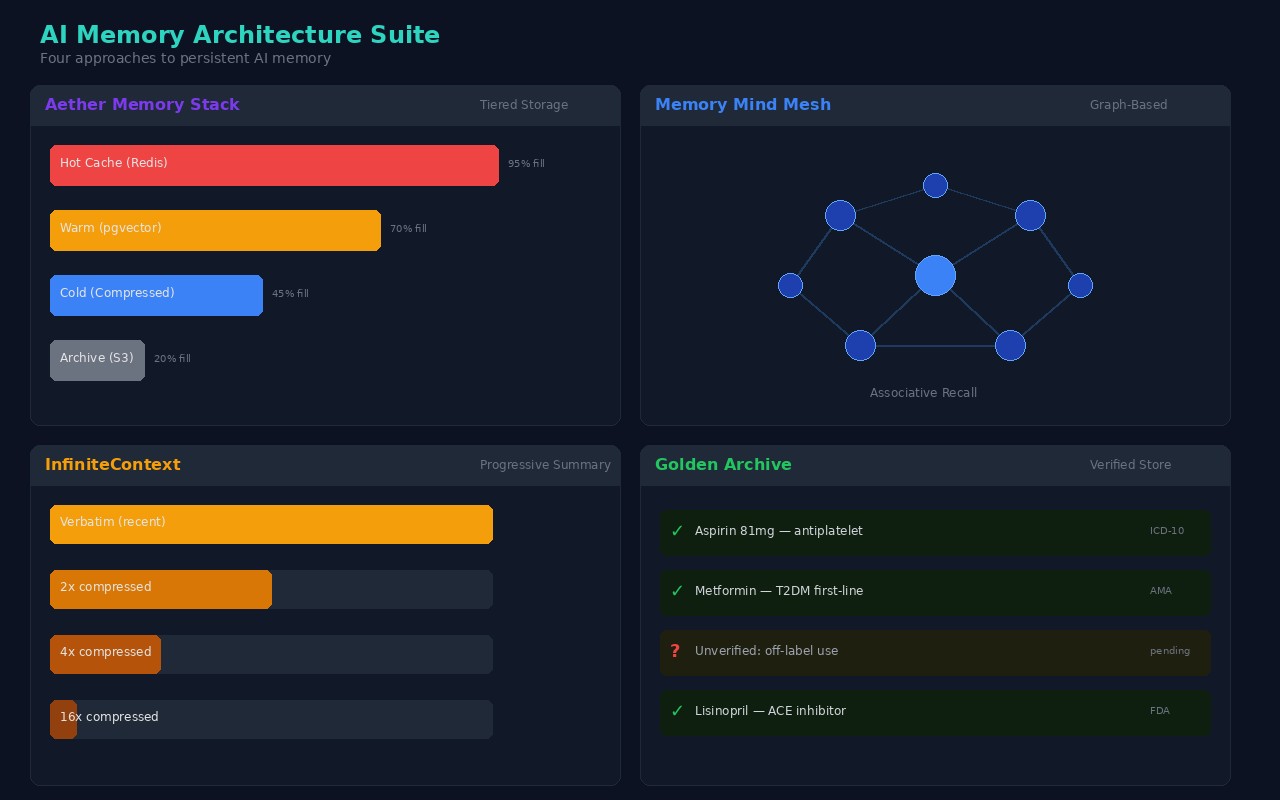
Memory Mind Mesh is the flagship of a broader investigation into persistent memory — Aether Memory Stack (tiered cache-style memory), InfiniteContext (progressive summarization for windowless conversations), and Golden Archive (validation-gated knowledge store) are early explorations in the same line. Memory Mind Mesh is the furthest developed of the three, though it has had no substantive commits since June 2026 (the last push, on 2026-06-09, was CI plumbing). Of the three explorations, InfiniteContext is public (source on GitHub), while Aether Memory Stack and Golden Archive are not publicly distributed.
What’s Needed For This Entry To Tighten
- A public source repository linked via
githubUrl, and/or - A downloadable, usable public artifact (release binary, package, or runnable distribution).
Verification
Full proof report → All claims, all projects →- Empirical benchmark
After corrections, accuracy on held-out phrasings improves: mean embedding cosine-to-gold 0.60 → 0.99 across 10 single-fact memories with 3 corrections each, 10 topics improved and 0 regressed (gpt-4o-mini, temperature 0)
memory-mind-mesh eval/receipt.json (private repo; reproduced byte-identical at temperature 0)
- In progress
Public source repository linked via githubUrl, or a downloadable usable public artifact (release binary, package, or runnable distribution)
Related work
-
beta
SUM — Verifiable Bidirectional Knowledge Distillation
Cryptographic provenance for AI knowledge transforms. Every transform — render, extract, compose, slider — emits a signed receipt anyone can verify offline. Six-regime compliance validators (EU AI Act, GDPR, HIPAA, SOC 2, ISO 27001, PCI DSS) and a layered sum verify --explain output landed in v0.7.0; the current PyPI release is v0.12.0. Same bytes verify identically in Python, Node, and modern browsers.
-
in-development
HFAO — Hugging Face Agent Observatory
Observe and debug AI agents in production. Trace every step an agent takes, evaluate outputs against expected behavior, and watch quality drift before users do. Open-source, standards-native (OpenTelemetry GenAI + OpenInference), MCP-queryable, Apache-2.0.
-
in-development
InfiniteContext — Tiered Memory for AI
An extensible memory layer that pushes past model context limits: a hierarchical bucket store with exact-flat persistence and approximate (HNSW) retrieval at scale, automatic categorization, multi-level summarization, and pluggable storage tiers from local disk to cloud. Public, MIT-licensed TypeScript library + CLI.