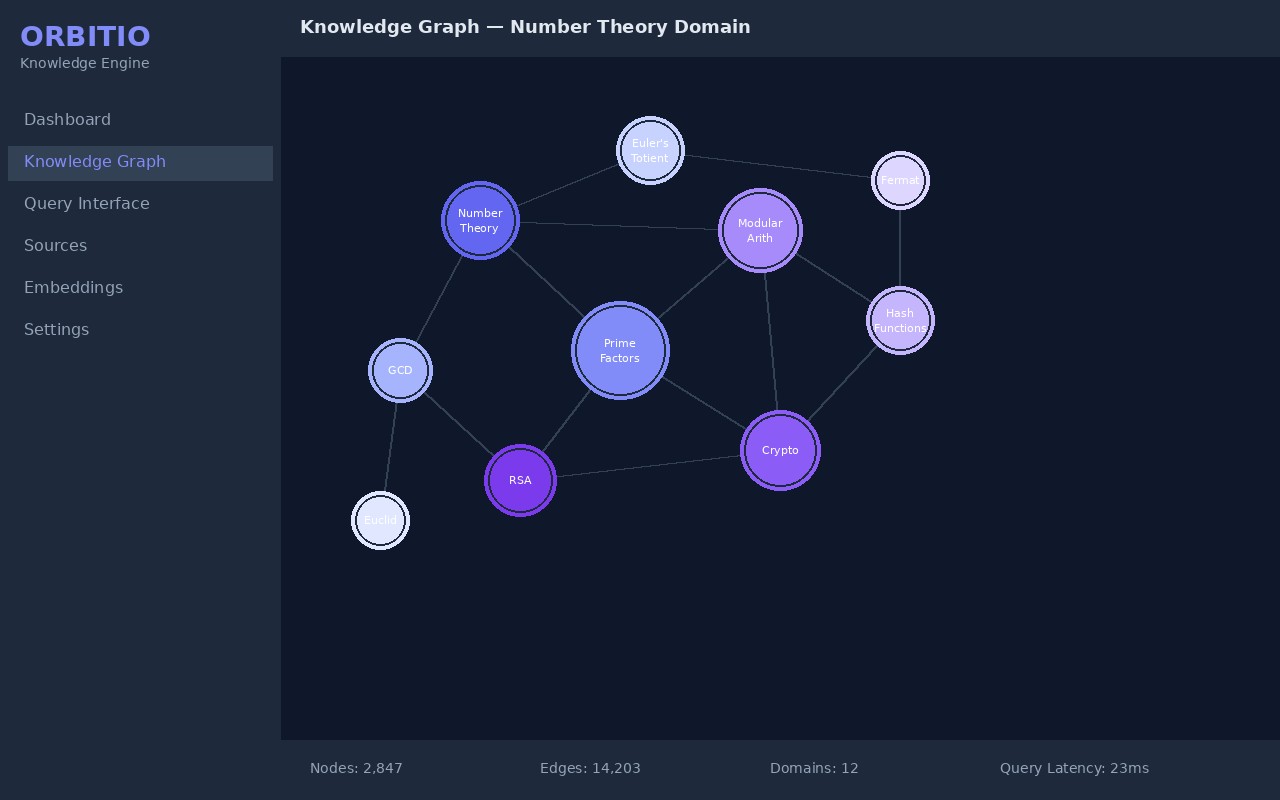
Status: in development, no public artifact yet. The source repo is private and there is no live demo a visitor can interact with. The description below reflects the local-bring-up state of the system, not an externally-verifiable shipping product.
“ORBITIO — where every idea finds its orbit.”
A self-organizing knowledge engine. Feed it notes; it organizes them into a navigable, queryable space, auto-tags and summarizes content, and surfaces relationships through a visual knowledge garden.
What teams can do with Orbitio
- Stop losing what they already know. Notes, captures, and references become a connected graph instead of a folder of orphaned files.
- Discover unexpected links. Similarity alerts surface connections between new content and prior thinking that flat search would miss.
- Capture in one motion. A browser extension lets web content land directly in the knowledge base without copy-paste rituals.
- Stay in sync across surfaces. A local watcher keeps an existing notes folder mirrored into the engine without changing the writing workflow.
Typical use cases
- Researchers and analysts building a personal knowledge graph that grows with reading.
- Consulting teams maintaining cross-engagement institutional memory that survives turnover.
- Founders and operators keeping market, product, and competitive notes navigable across many domains.
Status
The core ingest → embed → search path runs end-to-end, and a committed retrieval eval records a flat keyword baseline of recall@1 = 0.83, recall@3 = 1.0 on an 18-question golden set; vector and Ragas metrics await a keyed eval run. The backend suite collects 35 tests (no external infrastructure): 34 pass and one fails, test_refresh_token_rotates_and_revokes. That failure is a test-harness artifact rather than a defect in the code under test — the test passes a per-request cookie that merges with the client’s cookie jar, and probing the rotation function directly rejects the replayed token. Because the local Lefthook pre-push gate runs that same suite as its backend step, the gate does not currently pass.
Hosted CI last ran on 2026-06-13 and was blocked by an account-level GitHub Actions billing pause. Account-level Actions billing has been intermittent since — runs succeeded elsewhere on the account on 2026-08-27, and were refused again on 2026-08-28 — and no Orbitio run has been re-triggered either way, so the red check reflects that stale blocked run rather than a fresh execution of the current suite. Last repo activity was also 2026-06-13, and the repo’s own README describes the project as pre-alpha (2026-06).
Beyond the search path, the repo includes an MCP adapter (backend/mcp_server.py) exposing ingest, search, synthesize, and contradictions as tools, so the engine can be called as a retrieval service by other agents. Planted evaluation sets with scorers for contradiction detection and knowledge-gap recall are also committed, though their scores are unproduced and recorded as skipped pending the same keyed run. The README also lists four things as design notes that are not implemented: VR / 3D spatial navigation of the knowledge graph; federated or collaborative gardens and collective-intelligence features; mobile apps, AR overlay, and Obsidian/Notion plugins; and custom fine-tuned or multi-agent exploration models.
The repo is private with no public artifact, so none of this is externally interactive. Source and architectural detail are not currently published; case study and technical deep-dive available on request for serious inquirers via the contact page.
What’s Needed For This Entry To Tighten
- A public demo URL exposing the knowledge garden view, and/or
- A public source repository linked via
githubUrl.
Related work
-
in-development
GAINS — Gesture-Assisted Intelligent Note Scribe
Hands-free desktop note-taking: speak to capture, nod to commit. Tauri 2 + Leptos shell over Python services (faster-whisper ASR, MediaPipe Tasks head pose, Piper TTS) on a ZeroMQ plug-in bus.
-
beta
SUM — Verifiable Bidirectional Knowledge Distillation
Cryptographic provenance for AI knowledge transforms. Every transform — render, extract, compose, slider — emits a signed receipt anyone can verify offline. Six-regime compliance validators (EU AI Act, GDPR, HIPAA, SOC 2, ISO 27001, PCI DSS) and a layered sum verify --explain output landed in v0.7.0; the current PyPI release is v0.12.0. Same bytes verify identically in Python, Node, and modern browsers.